New Zealand’s hardest mountains to climb
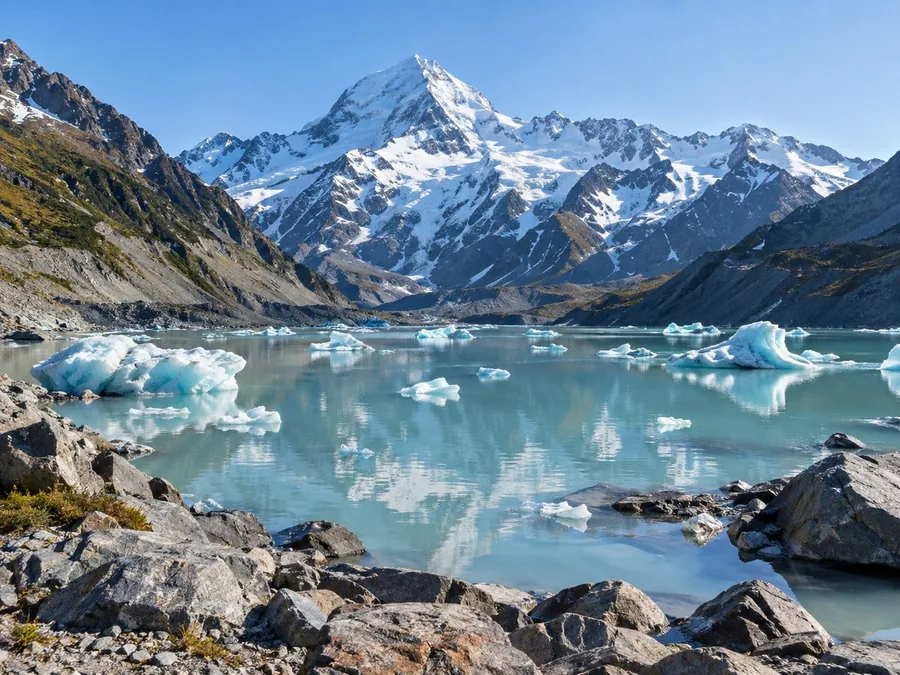
Only one day at Mount Cook?A small-group day tour gets you onto the Hooker Valley Track from Queenstown, Christchurch or Lake Tekapo without the long drive at the wheel, and a scenic flight from Mount Cook Airport lands you in the snow above the Tasman Glacier. These are the options worth comparing.
Compare the toursThe peaks often named in New Zealand
“Hardest” is opinion, and climbers argue about it. These are the four names that come up most often. I am a hiker, not a mountaineer, so I pass on what the sources say rather than my own experience.
| Peak | Height | Why it is named |
|---|---|---|
| Aoraki / Mount Cook | 3,724 m | Highest; the most technical of the common objectives |
| Mount Tasman / Horokōau | 3,497 m | Second highest; even its easiest route is a glacier, snow and ice climb |
| Mount Dampier | 3,440 m | Third highest; gendarmes and hard ice |
| Mount Aspiring / Tititea | 3,033 m | Long approach and glacier travel |
Aoraki / Mount Cook
The highest mountain in New Zealand is also the most technical of the peaks people commonly set out for. The normal route up the Linda Glacier is graded IV,3,3, with crevasses and ice and rock fall, and summit day is 15–18 hours return from Plateau Hut. It is also New Zealand’s deadliest peak; I deal with that soberly on how dangerous Mount Cook is. The route, the skills it takes and the history are on how hard Aoraki is to climb.
Mount Tasman and Mount Dampier
Mount Tasman, Horokōau, is the second-highest peak at 3,497 m. Even its easiest route is a glacier, snow and ice climb. It was first climbed in February 1895 by FitzGerald, Zurbriggen and Clarke. Mount Dampier, 3,440 m and third highest, is known for its gendarmes and hard ice. In one telling of the Ngāi Tahu story they are two of Aoraki’s brothers, Rārakiroa and Rakiroa, turned to stone; the story is on the Ngāi Tahu story of Aoraki.
Mount Aspiring / Tititea
At 3,033 m, Mount Aspiring / Tititea is the highest peak outside the Aoraki region and is often called the Matterhorn of the South. It was first climbed on 23 November 1909 by Head, Clarke and Graham. What makes it hard is the long approach and the glacier travel before the climb proper begins.
The top 5 hardest in the world
Lists differ, but these five come up most. Death-to-summit ratios have fallen as more people climb them, so every figure below carries its year.
| Mountain | Height | Why it is named |
|---|---|---|
| K2 | 8,611 m | “Savage Mountain”; about 800 summits and 96 deaths by August 2023, about 11% |
| Annapurna I | 8,091 m | About 13% (75 deaths in 559 ascents, as of February 2025); avalanche danger |
| Nanga Parbat | 8,126 m | “Killer Mountain”; the Rupal Face rises 4,600 m |
| Kangchenjunga | 8,586 m | 532 summits and 52 deaths, about 10%, as of May 2022 |
| Eiger North Face | About 1,800 m face | “Mordwand”; over 70 deaths by 2013 |
K2, the “Savage Mountain”, saw about one death for every four summits before 2021; by August 2023 it had about 800 summits and 96 deaths, roughly 11%. In January 2021 it became the last 8,000 m peak climbed in winter. Annapurna I has historically had the highest death-to-summit ratio of the 8,000 m peaks, about 13% on Guinness figures from February 2025, largely because of avalanche danger. Nanga Parbat, the “Killer Mountain”, has the Rupal Face, which rises 4,600 m and is the highest mountain face on Earth; 31 people died on it before the first ascent in 1953. Kangchenjunga had 532 summits and 52 deaths as of May 2022, about 10%. The Eiger North Face in Switzerland is a different kind of hard: a wall of about 1,800 m, called the Mordwand, first climbed in 1938, with over 70 deaths by 2013.
Where Aoraki sits
Aoraki is far lower than the Himalayan giants, and altitude is not what makes it hard. What makes it serious is the ground and the weather: crevasse fields, ice and rock fall on the Linda Glacier, and westerlies off the Tasman Sea that bring cloud and rain all year. Guided climbers usually allow about a week to catch one clear summit day. For people who want to stand near it without a rope, the hikes are compared on the hardest hikes in New Zealand.
The high peaks from the air
GetYourGuide sells nothing on the summit of Aoraki and no guided Hooker Valley walk as such. What it does sell, close to the mountain, are two scenic flights from Mount Cook Airport. The 25-minute helicopter flight leaves Mount Cook Airport, near the village, and flies up the Tasman Valley over a glacier lake to an alpine landing facing Aoraki, where you get out and stand in the mountains for a few minutes. There is snow at the landing site most of the year, but not always in summer, and the time on the ground counts inside the 25 minutes. The passenger weight limit is 116 kg, and wind or cloud can cancel it, in which case you are offered another flight or a full refund. Full refund if you cancel up to 24 hours ahead.
The longer flight shows you the climbers’ side of the mountain, including the Grand Plateau where the normal route begins. The 45-minute combo goes one way by ski plane and one way by helicopter, up the Tasman Valley past the Hochstetter Icefall, Aoraki, the Grand Plateau and Plateau Hut, and lands on the snowfields of the upper Tasman Glacier, where there is snow all year. You give every passenger’s full name and weight when you book. Weather and wind cancel flights, sometimes several days running, so leave a spare day. Amy, from the United States, put it well: “Plan to be flex on timing because of weather, but worth the wait.” Full refund if you cancel up to 24 hours ahead.
Frequently asked questions
What is the hardest mountain to climb in New Zealand?
There is no official answer, but Aoraki / Mount Cook, 3,724 m, is usually named first, with Mount Tasman and Mount Dampier close behind and Mount Aspiring / Tititea the classic outside the Mount Cook region.
What are the top 5 hardest mountains to climb?
Lists differ, but K2, Annapurna, Nanga Parbat and Kangchenjunga are usually named for danger, with the Eiger’s North Face the classic hard Alpine wall.
Which mountain has the highest death rate?
Annapurna I has historically had the highest death-to-summit ratio of the 8,000 m peaks, about 13% as of February 2025.
How hard is Aoraki compared with the Himalaya?
It is far lower, so altitude is not the problem; crevasses, ice and rock fall and the weather are. The details are on how hard Aoraki is to climb.
Can I see Aoraki and the Grand Plateau without climbing?
Yes, from the ski-plane and helicopter combo flight. Both flights are compared on the helicopter flights page.