How hard is Aoraki to climb?
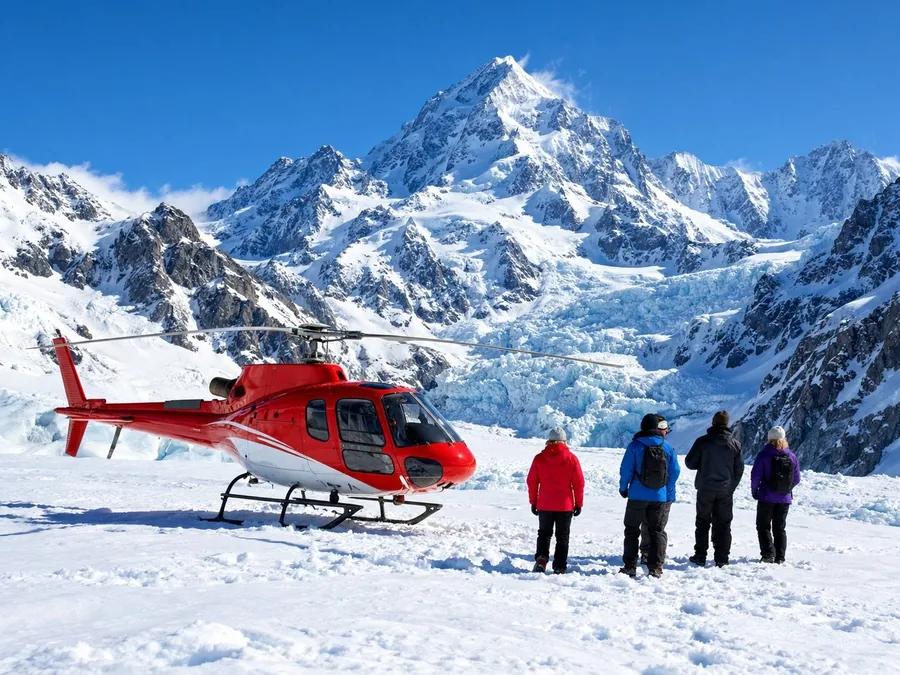
Only one day at Mount Cook?A small-group day tour gets you onto the Hooker Valley Track from Queenstown, Christchurch or Lake Tekapo without the long drive at the wheel, and a scenic flight from Mount Cook Airport lands you in the snow above the Tasman Glacier. These are the options worth comparing.
Compare the toursA climb, not a hike
This is the question I hear most from people passing through Twizel. The answer surprises some of them: every track in the park stays in the valleys or on the ridges below the ice. The Hooker Valley Track, the one most visitors walk, ends at Hooker Lake at the foot of the Hooker Glacier, with the summit still far above you. Everything past that point is mountaineering. I am a hiker, not a mountaineer, and I have never stood on top; what follows is what the climbing sources describe. The walk to the lake is on the Hooker Valley Track.
The Linda Glacier route
The normal route, and the most climbed, is the Linda Glacier from Plateau Hut on the Grand Plateau. It was first climbed in February 1912. It crosses crevasse fields on the glacier, then the Linda Shelf, then the Summit Rocks, then the summit ice cap. It is graded IV,3,3 on New Zealand’s Mount Cook system. The climbing database ClimbNZ notes that a large portion of the Linda Glacier is exposed to frequent ice and rock fall.
Summit day
Nobody walks in to Plateau Hut on a guided ascent; an aircraft takes you there and brings you back. Summit day leaves the hut at around 01:00 and takes 15–18 hours return, with about 1,700 m of climbing, crevasse crossings and ice climbing on the Summit Rocks. The guided season runs roughly from late October to late December. Moist westerlies off the Tasman Sea bring cloud and rain all year, so guided climbers usually allow about a week and wait for a weather window.
What guided climbers need first
Guided ascents are not for beginners. The skills asked for before a guided climb include many days on crampons, recent 12-hour days in the mountains, rock-climbing ability and a high level of aerobic fitness. In other words, Aoraki is where a mountaineering apprenticeship leads, not where it starts.
Why it is taken so seriously
The hazards are large crevasses, ice and rock fall, avalanches and weather that changes quickly. Aoraki is New Zealand’s deadliest peak, and I set out what that means, and why the walking tracks are a different world, on how dangerous Mount Cook is.
A step short of the top
Aoraki is the most sacred ancestor of Ngāi Tahu, and standing on the summit is regarded as standing on the head of an ancestor. Out of respect for Ngāi Tahu, guided climbers stop just short of the very summit. The story behind that is on the Ngāi Tahu story of Aoraki.
The first ascents
The first attempt was in 1882, by the Rev. W.S. Green. The first ascent came on 25 December 1894, when Tom Fyfe, Jack Clarke and George Graham reached the top by the Hooker Valley and the north ridge. Freda du Faur became the first woman to climb it in 1910, with two guides, and in 1913 made the first Grand Traverse of all three peaks. Freda’s Rock, on the Hooker Valley Track, marks where her famous photograph was taken. Edmund Hillary cut his teeth here: his first real climb was Mount Ollivier in 1939, and he climbed Aoraki’s South Ridge (now Hillary Ridge) in 1948, five years before Everest.
What hikers do instead
You can get a long way up without a rope. The Hooker Valley Track is about 10 km return with barely 100 m of climbing and ends at a lake under the south face. Sealy Tarns is about 2,200 steps and 600 m up, with Aoraki across the valley. The biggest hike is the Mueller Hut Route: about 1,000 m of climbing to a hut at about 1,800 m, where you look straight across at the Hooker Valley and the mountain. In summer it suits fit trampers; in winter it needs mountaineering skills and gear. My notes are on the Mueller Hut hike.
Close to the summit, by air
GetYourGuide sells nothing on the summit of Aoraki and no guided Hooker Valley walk as such. What it does sell, close to the mountain, are two scenic flights from Mount Cook Airport. The 25-minute helicopter flight leaves Mount Cook Airport, near the village, and flies up the Tasman Valley over a glacier lake to an alpine landing facing Aoraki, where you get out and stand in the mountains for a few minutes. There is snow at the landing site most of the year, but not always in summer, and the time on the ground counts inside the 25 minutes. The passenger weight limit is 116 kg, and wind or cloud can cancel it, in which case you are offered another flight or a full refund. Full refund if you cancel up to 24 hours ahead.
If you want to see the ground a climber crosses, the longer flight is the one. The 45-minute combo goes one way by ski plane and one way by helicopter, up the Tasman Valley past the Hochstetter Icefall, Aoraki, the Grand Plateau and Plateau Hut, and lands on the snowfields of the upper Tasman Glacier, where there is snow all year. You give every passenger’s full name and weight when you book. Weather and wind cancel flights, sometimes several days running, so leave a spare day. Amy, from the United States, put it well: “Plan to be flex on timing because of weather, but worth the wait.” Full refund if you cancel up to 24 hours ahead.
Frequently asked questions
How hard is Aoraki / Mount Cook to climb?
Very hard. It is a technical mountaineering climb on the Linda Glacier route, graded IV,3,3, with crevasses, ice and rock fall and a summit day of 15–18 hours return from Plateau Hut. Guided climbers need prior alpine experience.
Can you hike to the top of Mount Cook?
No. No walking track or route goes to the summit. The highest point a hiker usually reaches is Mueller Hut, at about 1,800 m on the ridge opposite.
How long does it take to climb Aoraki?
Guided climbers usually allow about a week to catch a weather window. They fly to Plateau Hut, and the summit day itself is 15–18 hours return, starting at around 01:00.
Who first climbed Aoraki?
Tom Fyfe, Jack Clarke and George Graham, on 25 December 1894. Freda du Faur was the first woman to climb it, in 1910.
Is Aoraki the hardest mountain in New Zealand?
It is the highest and usually named first. Mount Tasman and Mount Dampier are also often named; I compare them on the hardest mountains in New Zealand.
Can I get close to the summit without climbing?
Yes, from the air. Both scenic flights from Mount Cook Airport land in the mountains facing Aoraki; I compare them on the helicopter flights page.